
Why Can’t I Decide to Quit My Job? (It’s Not Indecision)
The data doesn’t lie and I’m obsessed. As a career transition coach who partners with midcareer millennials, visits to my website peak on Tuesdays and flatline over the weekend. And it shows me exactly what you are experiencing.
Let me know if I have this right: You’ve been exceeding expectations in your role for over ten years but you’ve been researching how to quit for the past two.
On Tuesdays by 3pm, you are googling: “career coach near me” or asking ChatGPT: “Why does midcareer change feel impossible?”
Over the weekend you’re sort of able to forget about the stress of the job but by the time Tuesday rolls around, you’re back to asking yourself “should I stay or should I go?”
You’ve written and rewritten the pros/cons lists but it hasn’t given you clarity around your decision or the conviction to act. You’re still counting down the days to your PTO.
If you already know you want to leave your job but can't act, the problem probably isn't indecision. It's being stuck between a decision that, deep down, you’ve already made and the fear of acting on it.
Here, we’ll talk about why that happens and a simple yet powerful tool that will help you to look at your decision with fresh eyes AND take action. Whether that’s intentionally choosing to stay in your current job or finally pressing send on the resignation letter you’ve had drafted for weeks.

How Your Brain is Holding You Back
After spending over 300 hours coaching midcareer pros navigate career transition, here’s what I know: just because you’ve made up your mind doesn’t mean you’re ready to take action. There’s so much that gets in the way. Including our brains.
Did you know that humans make over 35,000 decisions a day? If you’re stuck in the indecision of making a career pivot, it’s likely that your brain is trying to protect you.
Our brains force us to take mental shortcuts. Narrow framing, the sunk cost fallacy, and values conflict are cognitive biases that make career decisions feel impossible. So let’s break down these common career decision blockers. Because having awareness around what’s getting in the way is the first step to taking your next step.
Narrow Framing
Narrow Framing is our tendency to consider two binary choices. For example, “I can stay and suffer in this job or quit without a plan.” And the main reason why the pros/cons lists don’t really work.
Sunk Cost Fallacy
The sunk cost fallacy happens when we stay in something because of what we've already invested, not because it's the best path forward. It usually sounds like: “The past 15 years will be wasted if I change direction now.”
Values Conflict
Happens when our own differing beliefs that are in conflict with one another that prevent you from making a decision. “If I prioritize flexibility for my family, I’m being irresponsible and selfish. If I stay, I’m honoring my value of stability but I’m missing out on my family’s most important moments.”
The reason you keep going in circles is because you’ve written, and rewritten, the pros and cons list and somehow all three of these show up on it. “Stability” sits in one column and “Irresponsible” sits in another. “15 years of experience” becomes a pro for staying even when it’s the sunk cost fallacy talking. The list doesn’t actually move you to action, it just makes you feel even more confused. You’re caught in that loop of binary thinking: “should I stay, should I go?”
What to Do Instead of a Pros/Cons List
There is another way! It’s a framework called the Pain/Gain Model that helps you break out of binary thinking, assess your options, and highlight where your values may be in conflict.
The Pain/Gain Model is not just a fancy pros/cons list. It’s a brainstorming and decision making tool that uncovers the thoughts and feelings that impact not only your decision making but your ability to take action on your choice. This model makes your options more tangible because it uncovers the real costs and what you stand to gain no matter the choice you make.
The model is a 4-box matrix that highlights the pains and gains for each of your options, including the pain and gain of both your current and future states.
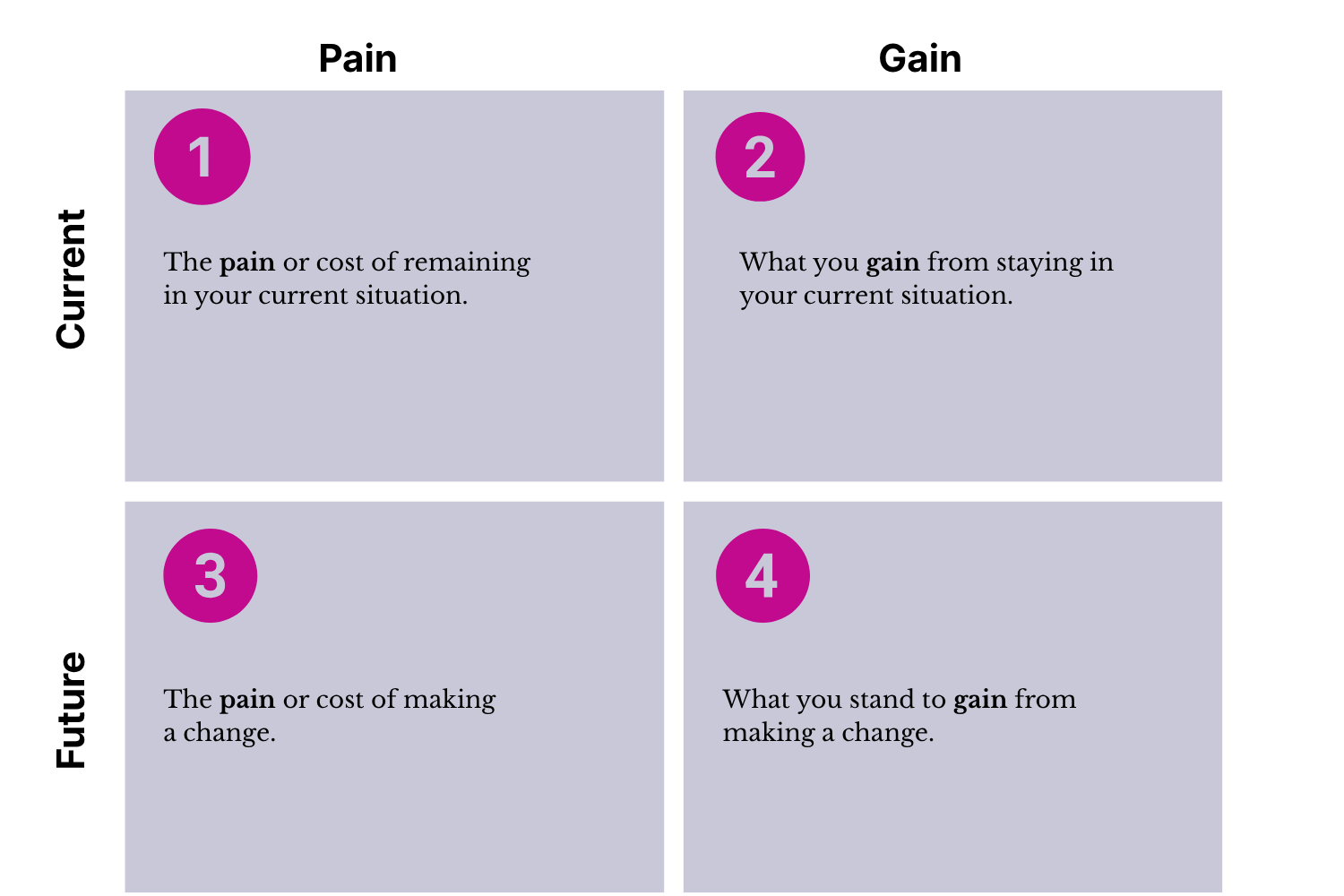
The Pain/Gain Model
The Pain of Staying
Even though everything on paper looked fine, when we started brainstorming using the Pain/Gain Model, one client realized that the cost of staying meant sacrificing her happiness and mental health, and growth opportunities.
The Gain of Making a Change
When she pictured actually making the change and what she stood to gain, what excited her most wasn’t necessarily a bigger pay check, it was a title that matched her level of experience and impact, the opportunity to stretch and learn, and more stability at a company that wasn’t prone to the ups and downs of a start-up.
The Gain of Staying
Often we don’t have what we want because it means giving up something that we currently have, which can be scary! Identifying how your current situation benefits you can be helpful and gives you more clarity and the choice to replace these benefits with even greater ones.
My client said: “I know what I’m doing, I make good money, it’s stable. I love the people, I’m respected, and there is flexibility.”
The Pain of Making a Change
For midcareer millennials the cost of the change can be scary. The amount of time to onboard, the perceived slope of the learning curve, the worry of "what if the grass isn’t greener?”, or “what if I’m not good enough to hack it someplace new?” These deeper fears speak to the true cost of making a career change.
How can a career transition coach help me to quit my job?

The beauty of the Pain/Gain Model is that it highlights your real motivations and real fears about making a career change.
Now, you might be wondering: can a coach really help me figure this out? Can’t I just complete the Pain/Gain Model on my own?
To that I say: working with a career coach isn’t going to automatically hand you a decision. And while there are no guarantees, what working with a coach can do is…
Brainstorm buddy: Challenge you to fill out all four boxes, not just the two that are “easiest.”
Ask the questions you might be avoiding and prompt you to step back and reflect on what you're seeing
Get honest about the real costs financially, spiritually, emotionally, socially and have a real conversation to make sure fear isn’t holding you back.
Work with you as you develop a specific first step (with a deadline attached!)
Hold you accountable and check in on whether you actually did the thing you said you’d do.
The Real Cost of Staying Stuck
You're not stuck because you can't decide; you're stuck because you likely already have but the typical pros/cons list makes your choices more confusing. And acting despite that confusion feels harder than enduring the “pains” of staying. That's why every Tuesday by 3pm, you're right back to googling "career coach near me."
My clients who have been sitting in this loop for 6 months, 12 months often tell me the same thing: they aren’t engaged in their work because they are so tired and burned out from going back and forth. While the specific “pains” look different for everyone, the result is that typically, my clients feel stuck in one way or another.
If you've been thinking about a career change for six months, a year, two years, and you feel like you're going in circles, it's no wonder. You've been missing half of the information you need to make a choice, and the confidence to act on it.

What Comes Next?
If you want to map out the Pains and Gains for your own situation, I've got a free 25 minute workshop that walks you through it step by step. It's called "Should I Stay or Should I Go?".
In 25 minutes you’ll: Name the hidden factors impacting your career change decision so you finally understand WHY you can’t choose and stop blaming yourself for being stuck.
Complete the Pain/Gain Model with guided prompts from me so you walk away with more options than “stay and suffer” or “quit today with no plan.”
Identify the internal blockers that keep you frozen even after you've made up your mind.